La judéité, la transmission et la survie
Les Choses humainesJewish identity, transmission, and survival are not a settled inheritance in the novel but a pressure that changes meaning under threat. For Adam Wizman, the obligation to preserve Jewish life first appears as a response to violence and a history of vulnerability; it later becomes entangled with migration, religious practice, family duty, and his hesitation to leave his marriage. The concept gives private choices a collective weight, while the consequences of those choices show that safety and belonging do not always coincide.
Inheritance and the fear of disappearance
Adam grows up in a protective, affectionate Jewish family whose North African immigrant parents make their children’s education and what they call Jewish values central to their lives. His father is an accountant and his mother a social worker; at home they observe tradition, while outside the home they are relatively secular. This combination places Jewish identity in both everyday practice and a deliberate project of transmission.
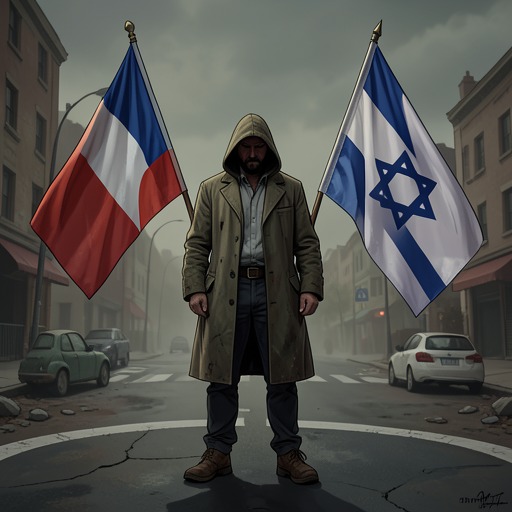
The 2012 attack on the Jewish school attended by Adam’s daughters turns inherited concern into immediate danger. After a gunman kills three children and a father, Adam and his wife remove their daughters from the school and decide to leave France. Their conversations return to the fear that European Jews can no longer ignore an antisemitism that kills, and that they or their children may eventually have to leave to escape both danger and the burden of tolerating the intolerable.
Adam’s understanding of that threat is sharpened by his reading of Georges Perec’s La Disparition. He tells Claire that, in Jewish tradition, the world was created through letters, and that removing even one letter from the Bible’s original text alters its meaning. He reads Perec’s decision to write without the letter e as an unconscious trace of the possibility of Jewish disappearance. The literary constraint becomes a figure for the precariousness he sees in Jewish continuity: survival can seem to depend on guarding what might be erased.
Migration, safety, and belonging
The family’s move to Ra’anana, Israel, is an attempt to act on that fear. They rent an apartment for six months, but the experience becomes a failure rather than a straightforward homecoming. Adam feels attached to the land, yet believes that fitting in would require him to deform himself. He finds daily life aggressive, feels uneasy amid the constant familiarity of living among other Jews, and discovers that the closeness he experiences when meeting Jews abroad does not translate into a sense of solidarity in Israel.
The failure is also political. Adam is troubled by the absence of political consciousness among people who emigrated for reasons like his own. To him, the Israeli-Palestinian conflict has become an abstract reality that they deny or accept as inevitable in exchange for personal security and quiet. He sees this acceptance as a moral defeat incompatible with the humanist Judaism he claims. Returning to France therefore does not resolve the conflict: the family comes back chastened, and Adam takes a French-teaching post at a Jewish school, living within a closed communal world.
The January 2015 attacks at Charlie Hebdo and the Hyper Cacher at the porte de Vincennes renew the pressure of survival. For three days Adam cannot work and stays at home with his wife and daughters, the shutters closed. The narration presents the family’s shared vulnerability as a bond that can hold them together more strongly than love. Jewish identity here is at once a source of continuity and a response to recurring violence, intensified by the sense that history is repeating itself.
Religious practice and the cost of continuity
After the family’s return, Adam’s wife becomes increasingly observant. She abandons the name Valérie and calls herself Sarah, changes from trousers and low-cut shirts to long skirts and loose, long-sleeved clothing, covers her head, and seeks stricter observance of dietary rules, Shabbat, and family-purity laws. These rules prohibit contact between spouses from the first day of menstruation until the twelfth day afterward, followed by immersion in a ritual bath at night. During the separation, Sarah sleeps on a mattress on the floor, an arrangement Adam cannot bear to see.
For Adam, this intensification of religious life makes the household feel less like shared continuity than estrangement. He has remained faithful for nearly twenty years to a wife who supported his professional ambitions and cared for their children, and he sings “The Virtuous Woman” for her each Friday evening at her request. Yet at forty-two he feels that he is living with a stranger, without desire or a future. The tradition he honors through the song and through family life cannot by itself restore intimacy.
Desire, duty, and the decision to leave
Adam’s relationship with Claire forces the conflict between personal desire and communal obligation into the open. Neither had set out to have an affair, and both had appeared to others as models of marital stability. After two months, Adam tells Claire that he cannot commit to her because he is not ready to break up his Jewish home, leave the house where his family lives, provoke a separation, or lose daily contact with his daughters. He also fears surrendering the security that his existing life provides.
For a year, the relationship remains parallel to his marriage. Adam and Claire spend days together when they can, then return to homes shaped by guilt and a wish for calm. Their secret, largely erotic correspondence gives their relationship intensity but does not yet test it against ordinary domestic life. Adam understands that Claire has changed how he thinks and that he might become more fully himself with her, but imagines that leaving would make him an outcast: a Jew who has abandoned his household. He recalls the adolescent injunction that, as a Jew, he has duties and belongs to a people whose survival he must help secure.
The narrative links that injunction to a history of transmission and survival in a hostile environment, amplified by the attacks of 2012 and 2015. Adam eventually finds the courage to tell his family that he is leaving and to imagine the religious divorce his wife would need if she wished to rebuild her life. His decision does not erase his obligations; it reveals how the demand to preserve a family and a community can collide with the demand to live honestly. Jewish identity thus operates neither as simple protection nor as a mere obstacle, but as an inheritance Adam must interpret at a cost.
Family across borders
The consequences of separation extend the theme of transmission into the next generation. A few weeks after the separation, Adam’s former wife tells him she is taking their daughters to Brooklyn, to Crown Heights, a heavily religious Jewish neighborhood. Adam does not oppose the move; he prefers the distance, and Claire does not want to share a week-on, week-off life with his daughters. Their retreat into their new relationship brings happiness, but also estranges them from their families and conflicts with the identities they had held as attentive parents and faithful spouses.
The family’s geography becomes more complicated when Mila, Adam’s elder daughter, arrives at Adam and Claire’s home with a suitcase, unable to bear life in New York and the religious community her mother has joined. She objects to the control over how she dresses, walks, and thinks. Her later account of her history connects the 2012 school attack, the failed move to Israel, her mother’s religious turn, and her mother’s departure to a prolonged instability. The family’s migrations and religious choices are therefore not abstract disputes about belonging: they alter where the children live, whom they feel abandoned by, and how securely they can inhabit their own lives.
The novel gives no uncomplicated resolution to the question of survival. The wish to protect Jewish children from antisemitism leads Adam’s family across borders, but migration fails to secure a settled sense of belonging; religious continuity offers a framework for life, but can also become a source of estrangement and control. By following the effects of these choices through Adam, Sarah, and Mila, the narrative presents Jewish identity as both collective inheritance and intimate negotiation: a history carried forward through family, but never without conflict over what that inheritance demands.